وزارة التربية والتعليم العالي تدشّن ثانوية كفرزبد الرسمية بالشراكة مع اليونيسف ودعم من فرنسا، في خطوة تعزّز الوصول إلى تعليم نوعي وشامل للجميع
وزارة التربية والتعليم العالي تدشّن ثانوية كفرزبد الرسمية بالشراكة مع اليونيسف ودعم من فرنسا، في خطوة تعزّز الوصول إلى تعليم نوعي وشامل للجميع
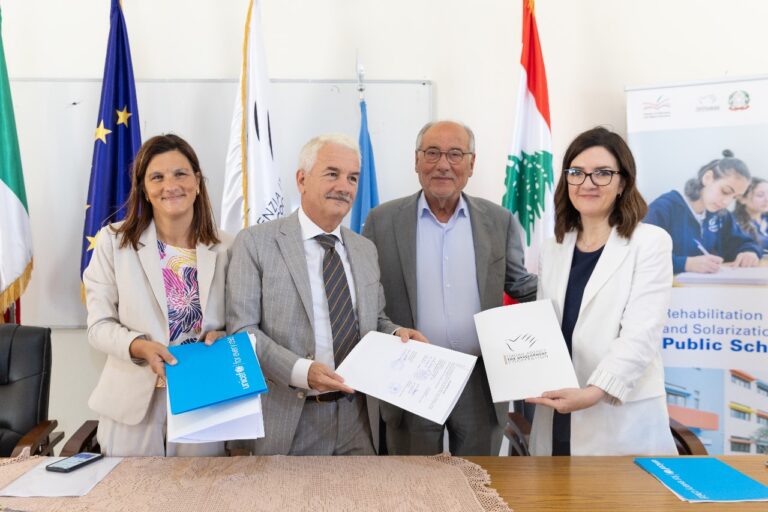
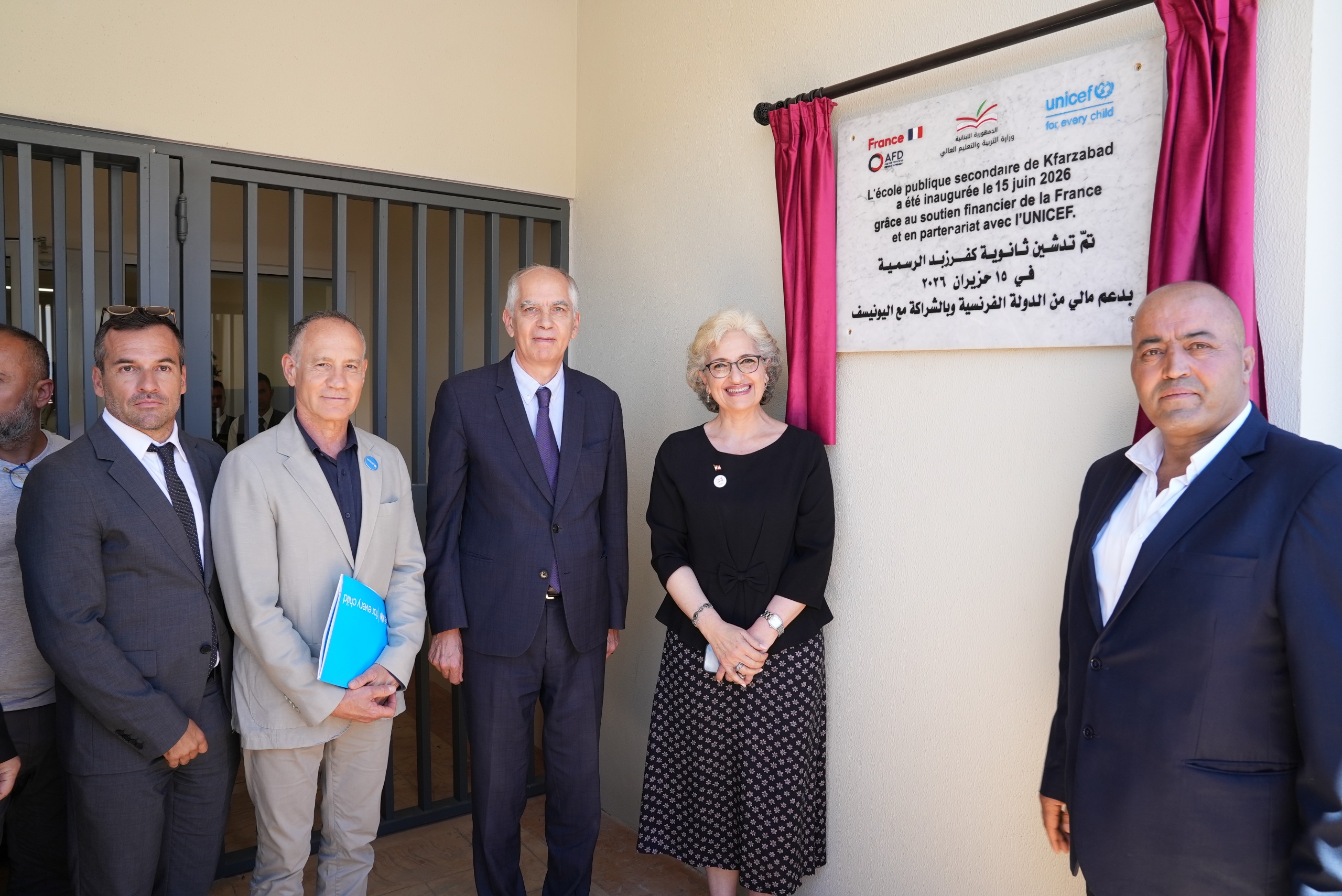
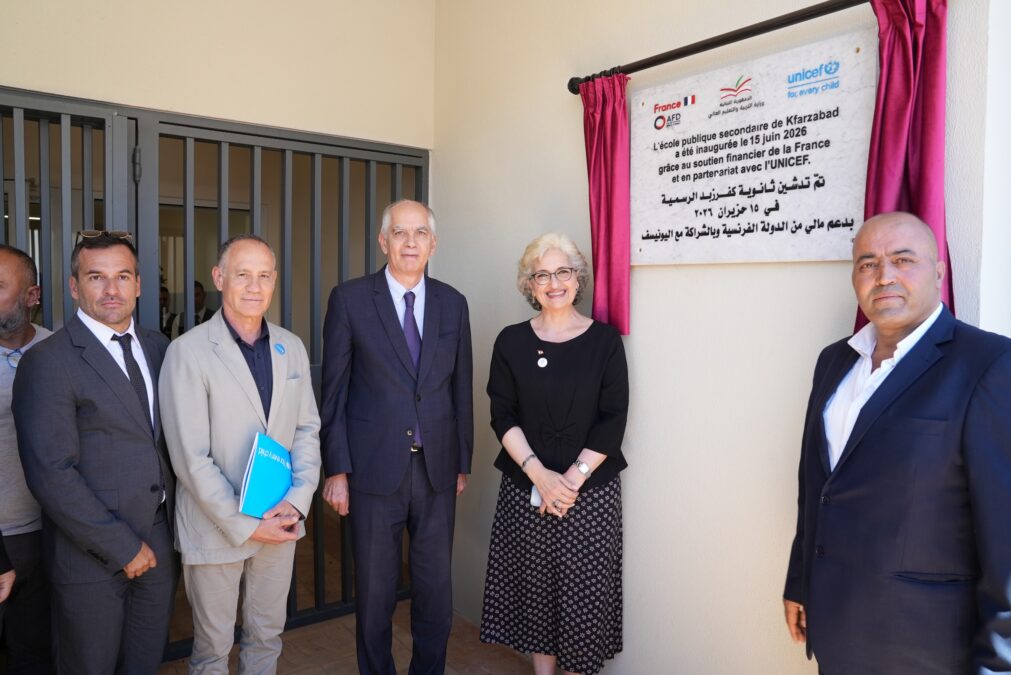
15 حزيران/يونيو 2026 – دشّنت وزارة التربية والتعليم العالي اليوم، بالشراكة مع وفرنسا واليونيسف، مبنى ثانوية كفرزبد الرسمية الجديد في البقاع، في محطة مهمّة نحو توسيع فرص حصول الأطفال والشباب في لبنان على تعليم نوعي، شامل، وغير منقطع.
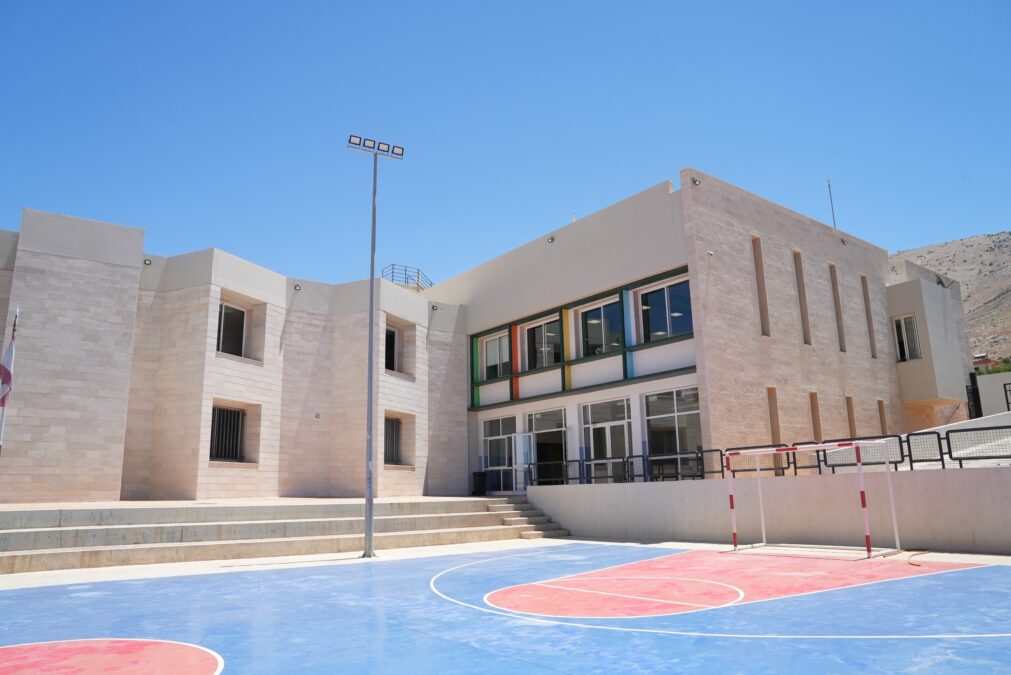
وقد تولّت اليونيسف أعمال تشييد المدرسة بدعم سخي من فرنسا على مدى نحو سنتين ونصف، لتوفّر بيئة تعليمية حديثة، آمنة ومستدامة للطلاب. ويضمّ المبنى صفوفاً دراسية إلى جانب مجموعة من المساحات التربوية المتخصصة، تشمل مختبرات، وورش عمل، وغرفاً للفنون والموسيقى، ومكتبة، وقاعة متعددة الاستخدامات، وملعباً، بالإضافة إلى المكاتب الإدارية والمباني الخدماتية. كما يضمّ الحرم المدرسي مساحات خارجية خضراء، ومرافق رياضية وترفيهية، ومواقف للسيارات.
وزيرة التربية والتعليم العالي الدكتورة ريما كرامي قالت: “أن نقف هنا اليوم، في الظروف التي نعرفها جميعاً، لنفتتح ثانوية رسمية جديدة، هذا بحدّ ذاته موقف. موقف يقول إن الدولة ما زالت قادرة على البناء، وإن المدرسة الرسمية تستحق أن نراهن عليها، وإن أولادنا يستحقون أن نواصل العمل من أجلهم مهما كانت الظروف” وأضافت :” نحن في وزارة التربية والتعليم العالي نعمل اليوم وفق رؤية واضحة لقطاع التعليم. هدفنا الأول والأخير: تعليم جيد ومنصف لكل طفل في لبنان، بدون استثناء، وبدون تمييز.”
في وقت لا يزال فيه نظام التعليم في لبنان يواجه تحديات كبيرة، بما في ذلك الانقطاعات المتكرّرة في التعلّم نتيجة الأزمات المتداخلة والنزاعات، يبقى الاستثمار في البنية التحتية للمدارس الرسمية ضرورة أساسية. فالمدارس الآمنة، القادرة على الصمود، والشاملة للجميع لا تضمن استمرارية التعلّم فحسب، بل توفّر أيضاً للأطفال والمراهقين شعوراً بالاستقرار والحماية، وفرصاً لبناء مستقبلهم. ويُعدّ توسيع المرافق التعليمية وتحسينها أمراً أساسياً لدعم استمرارية التعلّم، وتعزيز القدرة على الصمود، وضمان عدم ترك أي طفل دون فرصة تعليمية.
وقال سفير فرنسا في لبنان، السيّد هيرفي ماغرو :”إن وجودي بينكم اليوم يجسّد التزام فرنسا المستمر بدعم لبنان.” وأضاف” في أوقات النجاح كما في فترات الشدة، تواصل فرنسا الوقوف إلى جانب الشعب اللبناني ودعم مؤسساته، من خلال جهودها الديبلوماسية، والسياسية، والإنسانية والإنمائية.”
وبدوره، ماركولويجي كورسي، ممثل اليونيسف في لبنان قال: “يشكّل افتتاح ثانوية كفرزبد الرسمية خطوة مهمّة لدعم التعليم الرسمي في لبنان والاستثمار في مستقبل الأطفال والمراهقين. ففي وقت واجه فيه العديد من الطلاب انقطاعاً متكرّراً في تعلّمهم بسبب الأزمات، يصبح توفير مدرسة آمنة وشاملة وداعمة أكثر أهمية من أي وقت مضى، ليتمكّن كل طفل وشاب من مواصلة التعلّم وتحقيق إمكاناته. نحن ممتنّون للدولة الفرنسية على شراكتها المستمرة ودعمها للتعليم في لبنان. وستواصل اليونيسف العمل مع وزارة التربية والتعليم العالي والشركاء لضمان حصول كل طفل في لبنان على تعليم نوعي ومستمر، دون انقطاع.”
وقد صُمّمت المدرسة وفق مبادئ البناء المستدام والقادر على الصمود، مع دمج أنظمة صديقة للبيئة تعزّز كفاءة استخدام الموارد وتخفّض تكاليف التشغيل. وتشمل هذه الأنظمة نظاماً لتسخين المياه بالطاقة الشمسية، ونظاماً لتجميع مياه الأمطار، ومحطة لمعالجة مياه الصرف الصحي لأغراض الري، بالإضافة إلى نظام لمعالجة المياه بتقنية التناضح العكسي (Reverse Osmosis). كما تساهم العوازل الحرارية المحسّنة واستخدام مواد منخفضة الانبعاثات في توفير بيئة داخلية أكثر راحة وصحّة للطلاب والمعلمين.
ولتعزيز القدرة على تأمين الطاقة، زُوّدت المدرسة بنظام للطاقة الشمسية الكهروضوئية بقدرة 34 كيلوواط ذروة (kWp)، بدعم من الوكالة الفرنسية للتنمية (AFD)، ما يخفّف الاعتماد على شبكة الكهرباء العامة ويسهم في ضمان استمرارية التعلّم. كما أنّ المدرسة مجهّزة بالكامل لتكون متاحة للأطفال ذوي الإعاقة، من خلال منحدرات مخصّصة، ومصعد، ومرافق صحية مهيّأة، بما يعزّز التعليم الشامل للجميع.
واستكمالاً لهذا الالتزام، دعمت الوكالة الفرنسية للتنمية أيضاً شراء وتركيب الأثاث المدرسي، بما يضمن تجهيز جميع المساحات التعليمية بشكل كامل. ومع استكمال أعمال تركيب الأثاث وتجهيزات الطاقة الشمسية، أصبحت المدرسة اليوم جاهزة بالكامل لتوفير بيئة تعليمية داعمة وقادرة على الصمود للطلاب والمعلمين.
انتهى
نبذة عن اليونيسف
تعمل اليونيسف في لبنان منذ أكثر من 70 عاماً، وفي بعض من أكثر الأماكن تحدياً حول العالم، للوصول إلى الأطفال الأكثر حرماناً. ومن خلال عملها في أكثر من 190 بلداً وإقليماً، تعمل اليونيسف من أجل كل طفل، في كل مكان، لبناء عالم أفضل للجميع.
للمزيد من المعلومات حول عمل اليونيسف في لبنان من أجل الأطفال، يُرجى زيارة: www.unicef.org/lebanon أو متابعتنا عبر منصات X ، وفيسبوك، وإنستغرام، ويوتيوب.
للمزيد من المعلومات، يرجى التواصل مع:
Blanche Baz – bbaz@unicef.org – +961 3 331 874
Maya Outayek – moutayek@unicef.org – +961 70 190 634
The Ministry of Education and Higher Education inaugurated Kfarzabad Secondary Public School in partnership with UNICEF with the support of France, advancing access to quality and inclusive education
15 June 2026 – The Ministry of Education and Higher Education (MEHE), in partnership with France and UNICEF, inaugurated today the newly constructed Kfarzabad Secondary School in the Bekaa, marking an important milestone in expanding access to quality, inclusive and uninterrupted education for children and young people in Lebanon.
Constructed by UNICEF with the generous support of France over a period of approximately two and a half years, the school provides a modern, safe and sustainable learning environment for students. The facility includes classrooms alongside a range of dedicated pedagogical spaces, including laboratories, workshops, art and music rooms, a library, a multipurpose hall, and a playground, in addition to administrative offices and service buildings. The campus is further complemented by landscaped outdoor areas, sports and recreational grounds, and parking facilities.
Minister of Education and Higher Education Dr. Rima Karami said: “Standing here today, in circumstances we all know too well, to inaugurate a new public secondary school is in itself a statement. It is a statement that the state is still capable of building, that public education is worth investing in, and that our children deserve our continued commitment, whatever the circumstances. At the Ministry of Education and Higher Education, we are working today with a clear vision for the education sector. Our first and foremost goal is to ensure quality and equitable education for every child in Lebanon, without exception and without discrimination”.
At a time when Lebanon’s education system continues to face significant challenges, including repeated disruptions to learning due to overlapping crises and conflict, investments in public school infrastructure remain essential. Safe, resilient and inclusive schools not only support continuity of learning but also provide children and adolescents with stability, protection and opportunities to build their future. Expanding and improving school facilities is critical to supporting continuity of learning, strengthening resilience, and ensuring that no child is left behind.
“My presence here today reflects the enduring commitment of France to stand alongside Lebanon,” said Herve Magro, Ambassador of France to Lebanon. “In times of progress as well as in periods of hardship, France remains fully mobilized, deploying the full range of its diplomatic, political, humanitarian and development instruments to support the Lebanese people and strengthen national institutions”.
“The inauguration of Kfarzabad Secondary School is an important investment in Lebanon’s public education system and in the future of its children and adolescents,” said Marcoluigi Corsi, UNICEF Representative in Lebanon. “At a time when many students have experienced repeated disruptions to their learning, expanding access to safe, inclusive and quality education remains essential. We are grateful to France for its longstanding partnership and commitment to education in Lebanon. This investment will help provide children and adolescents with a safe and supportive learning environment where they can learn and thrive. UNICEF remains committed to supporting the Ministry of Education and Higher Education and partners to ensure uninterrupted, quality education for every child in Lebanon.”
The school has been designed in line with sustainable and resilient building principles, integrating environmentally friendly systems that improve resource efficiency and reduce operational costs. These include a solar hot water system, a rainwater harvesting system, a sewage treatment plant for irrigation purposes, and a reverse osmosis water treatment system. Enhanced thermal insulation and the use of low-emission materials contribute to improved comfort and healthier indoor environments for students and teachers.
To further strengthen energy resilience, the school is equipped with a 34 kWp solar photovoltaic system, supported by the Agence Française de Développement (AFD), reducing dependence on the national electricity grid and ensuring continuity of learning. The facility is also fully accessible to children with disabilities, with ramps, an elevator and adapted sanitation facilities, promoting inclusive education for all.
Building on this commitment, AFD has also supported the procurement and installation of school furniture, ensuring that all learning spaces are fully equipped and ready for use. With the completion of furniture installation and solarization works, the school is now fully operational and well positioned to provide a conducive and resilient learning environment for students and teachers for years to come.
ENDS
About UNICEF
Working in Lebanon for over 70 years, UNICEF works in some of the world’s toughest places, to reach the world’s most disadvantaged children. Across more than 190 countries and territories, we work for every child, everywhere, to build a better world for everyone
For more information about UNICEF Lebanon and our work for children, visit www.unicef.org/lebanon/ or follow us on Twitter, Facebook, Instagram and YouTube
For more information please contact
Blanche Baz, bbaz@unicef.org +961 3 331 874
Maya Outayek, moutayek@unief.org +96170190634
La Ministère de l’Éducation et de l’Enseignement supérieur inaugure l’École secondaire publique de Kfarzabad en partenariat avec l’UNICEF et le soutien de la France, renforçant l’accès à une éducation de qualité et inclusive
15 juin 2026 – Le Ministère de l’Éducation et de l’Enseignement supérieur (MEHE), en partenariat la France et l’UNICEF, a inauguré aujourd’hui la nouvelle École secondaire de Kfarzabad dans la Bekaa, marquant une étape importante dans l’élargissement de l’accès à une éducation de qualité, inclusive et continue pour les enfants et les jeunes au Liban.
Construite par l’UNICEF grâce au généreux soutien de la France sur une période d’environ deux ans et demi, l’école offre un environnement d’apprentissage moderne, sûr et durable aux élèves. L’établissement comprend des salles de classe ainsi qu’un ensemble d’espaces pédagogiques dédiés, notamment des laboratoires, des ateliers, des salles d’art et de musique, une bibliothèque, une salle polyvalente et une aire de jeux, en plus de bureaux administratifs et de bâtiments de service. Le campus est également doté d’espaces extérieurs aménagés, d’installations sportives et récréatives, ainsi que de parkings.
La ministre de l’Éducation et de l’Enseignement supérieur, la Dre Rima Karami, a déclaré : « Être réunis ici aujourd’hui, dans les circonstances que nous connaissons tous, pour inaugurer une nouvelle école secondaire public est en soi une déclaration forte. C’est une affirmation que l’État est encore capable de construire, que l’école publique mérite que l’on continue d’y investir, et que nos enfants méritent que nous poursuivions nos efforts pour eux, quelles que soient les circonstances. Au ministère de l’Éducation et de l’Enseignement supérieur, nous travaillons aujourd’hui selon une vision claire du secteur éducatif. Notre objectif premier et fondamental est de garantir une éducation de qualité et équitable à chaque enfant au Liban, sans exception et sans discrimination. »
À un moment où le système éducatif libanais continue de faire face à des défis majeurs, notamment des interruptions répétées de l’apprentissage dues à des crises multiples et à des conflits, les investissements dans les infrastructures scolaires publiques demeurent essentiels. Des écoles sûres, résilientes et inclusives permettent non seulement d’assurer la continuité de l’apprentissage, mais aussi d’offrir aux enfants et aux adolescents un cadre de stabilité, de protection et des perspectives pour construire leur avenir. L’extension et l’amélioration des infrastructures scolaires sont essentielles pour soutenir la continuité de l’apprentissage, renforcer la résilience et garantir que nul enfant ne soit laissé pour compte.
« Ma présence parmi vous aujourd’hui témoigne de l’engagement constant de la France aux côtés du Liban, » a déclaré S.E. M. Hervé Magro, ambassadeur de France au Liban. « Dans les moments de réussite comme dans les périodes d’épreuve, la France demeure mobilisée à travers l’ensemble de ses instruments diplomatiques, politiques, humanitaires et de développement pour accompagner le peuple libanais et soutenir ses institutions. »
« L’inauguration de l’École secondaire de Kfarzabad constitue un investissement important dans le système d’éducation publique du Liban et dans l’avenir de ses enfants et adolescents », a déclaré Marcoluigi Corsi, Représentant de l’UNICEF au Liban. « À un moment où de nombreux élèves ont subi des interruptions répétées de leur scolarité, l’élargissement de l’accès à une éducation sûre, inclusive et de qualité demeure essentiel. Nous sommes reconnaissants envers la France pour son partenariat de longue date et son engagement en faveur de l’éducation au Liban. Cet investissement contribuera à offrir aux enfants et aux adolescents un environnement d’apprentissage sûr et favorable où ils pourront apprendre et s’épanouir. L’UNICEF reste engagé à soutenir le Ministère de l’Éducation et de l’Enseignement supérieur et ses partenaires afin de garantir une éducation de qualité, continue, pour chaque enfant au Liban. »
L’école a été conçue conformément aux principes de construction durable et résiliente, intégrant des systèmes respectueux de l’environnement qui améliorent l’efficacité des ressources et réduisent les coûts d’exploitation. Ceux-ci incluent un système de production d’eau chaude solaire, un système de récupération des eaux de pluie, une station de traitement des eaux usées destinée à l’irrigation, ainsi qu’un système de traitement de l’eau par osmose inverse. Une isolation thermique renforcée et l’utilisation de matériaux à faibles émissions contribuent également à améliorer le confort et la qualité de l’air intérieur pour les élèves et les enseignants.
Afin de renforcer davantage la résilience énergétique, l’école est équipée d’un un système solaire photovoltaïque de 34 kWc, soutenu par l’Agence française de développement (AFD), réduisant la dépendance au réseau électrique national et garantissant la continuité de l’apprentissage. L’établissement est également entièrement accessible aux enfants en situation de handicap, grâce à des rampes, un ascenseur et des installations sanitaires adaptées, favorisant ainsi une éducation inclusive pour tous.
Dans le prolongement de cet engagement, l’AFD a également soutenu l’acquisition et l’installation du mobilier scolaire, garantissant que tous les espaces d’apprentissage soient entièrement équipés et prêts à être utilisés. Avec l’achèvement des travaux d’équipement et de solarisation, l’école est désormais pleinement opérationnelle et en mesure d’offrir un environnement d’apprentissage favorable et résilient aux élèves et aux enseignants pour les années à venir.
اكتشاف المزيد من عَشرة | منصّة عَشَرة للمحتوى الموزون
اشترك للحصول على أحدث التدوينات المرسلة إلى بريدك الإلكتروني.